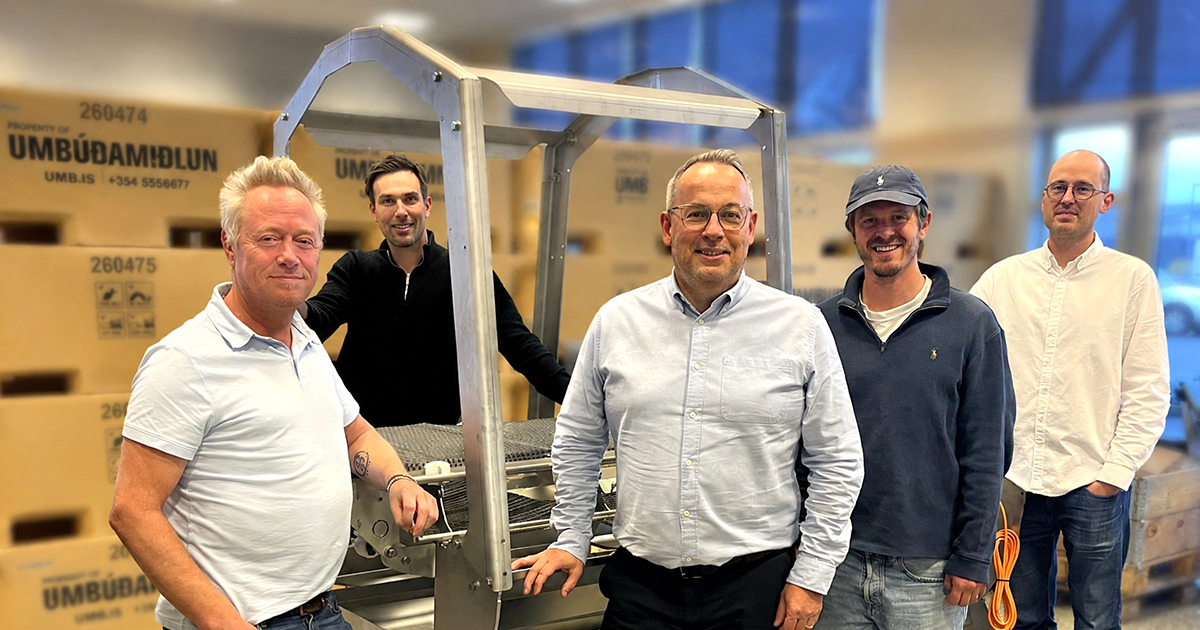
The Icelandic technology company PROCEON has successfully closed a ISK 60 million funding round, with Kría Venture Fund investing ISK 30 million and private investors, alongside the company's founders, contributing an equal amount in matching funding. The investment will support the continued development of AI-powered solutions designed to increase automation, improve resource utilization, and create greater value in the seafood and food processing industries.
PROCEON was founded in October 2025 by Trausti Árnason, Elías Jónsson, and Ragnar Guðmundsson, with the aim of helping companies in the seafood, aquaculture, and food processing industries improve value creation, raw material utilization, and operational efficiency through AI-powered solutions. Together, the founders bring decades of experience in developing and implementing advanced technology solutions for the food industry. PROCEON's solutions are designed to integrate with existing equipment and systems, regardless of manufacturer, enabling companies to leverage data and automation to improve decision-making, productivity, and sustainability.
PROCEON has already taken its first steps into international markets. Earlier this year, the company signed an agreement with a leading UK pelagic seafood company to deliver a complete roe processing solution. The first phase of the project was delivered at the end of July, ahead of the herring roe season, generating increased value from the processed products.
The funding will be used to complete the development and initial implementation of PROJET, an AI-powered waterjet cutting solution for salmon and whitefish. The technology combines computer vision, artificial intelligence, and precision cutting to automate the inspection and trimming of individual fish fillets in real time.
Today, fillet trimming remains a largely manual process, requiring workers to inspect each fillet, determine which parts need to be removed, and perform the necessary cuts. PROJET automates this process by using computer vision to analyze each fillet and adapt the cutting process to its specific characteristics and quality.
The goal is to reduce manual handling, eliminate subjective assessments, ensure consistent quality, and maximize yield by removing only what is necessary to meet quality standards while preserving as much valuable product as possible.
"The strength of the team is one of the most important factors we consider when investing in innovative companies. The PROCEON team brings an impressive combination of expertise, experience, drive, and a strong professional network. This is reflected in the fact that the company has already delivered its first project to an international customer and attracted private investors at this early stage. Supporting innovation in Iceland's core industries is also an important priority for the fund, and we look forward to following PROCEON on this exciting journey."
"We are extremely pleased to welcome Kría and the other investors on board. Their support means a great deal to us at this stage. Last autumn, when we as founders found ourselves at a crossroads, we saw numerous opportunities in the market and decided to take the leap and establish the company. Kría has been a tremendous source of encouragement and support throughout this process. Over the past months, we have been in close dialogue with companies in the seafood and food processing industries, both in Iceland and internationally, about the challenges facing the sector. These discussions have generated numerous ideas for solutions addressing real and unresolved industry problems, one of which received a grant from Rannís earlier this year. During the spring, the concept for PROJET began to take shape, and following a successful design phase, a prototype is now under construction. Market response has been very positive, and we believe PROJET has the potential to transform certain stages of fish processing."
PROCEON ehf. is an Icelandic technology company founded in 2025, developing AI-powered solutions for the seafood, aquaculture, and food processing industries. Across these sectors, valuable resources are lost every day due to manual processes, subjective assessments, and data that is not effectively utilized in decision-making.


