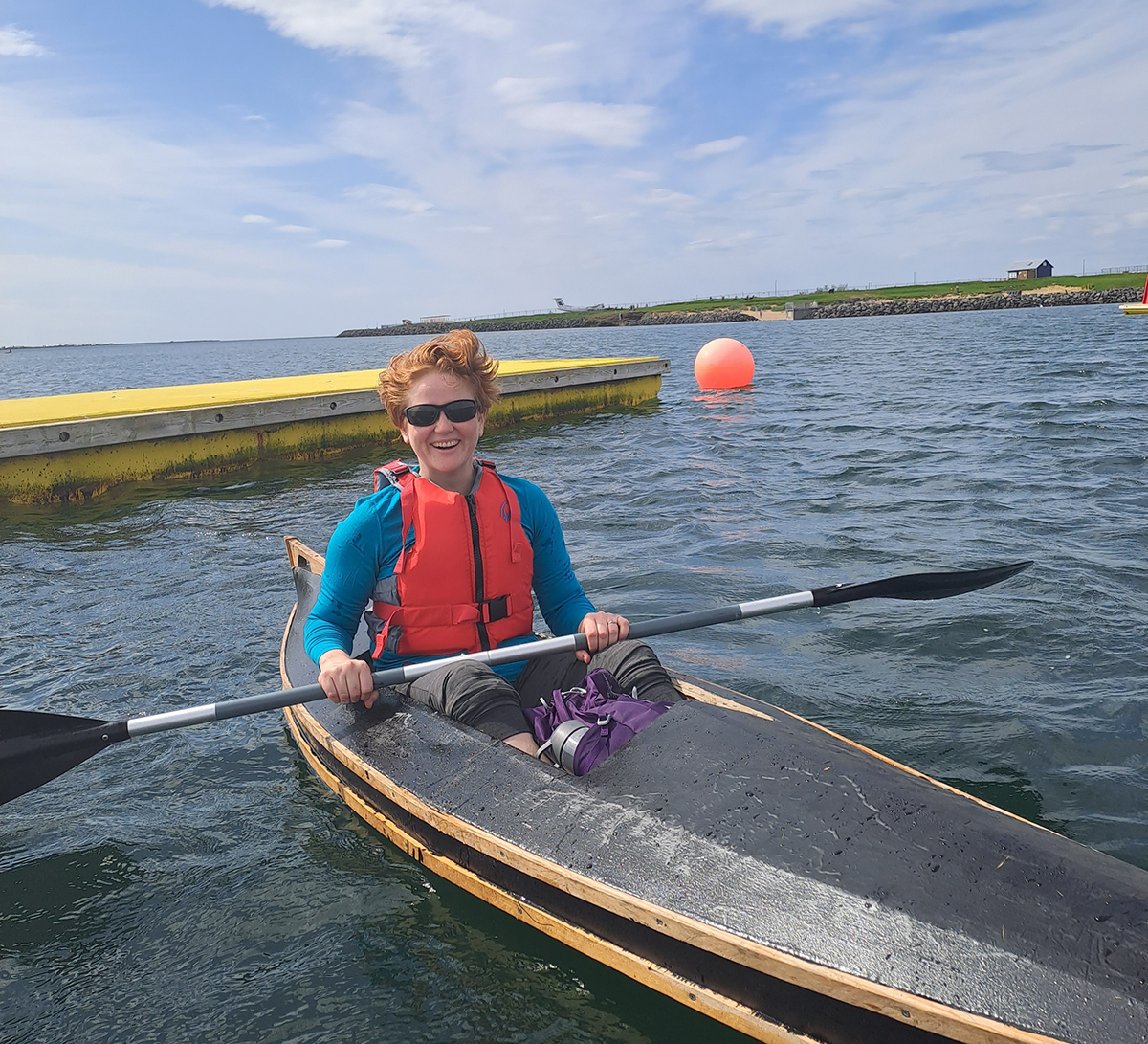
Helga Dögg Flosadóttir works as the CEO of Atmonia. Atmonia plans to produce nitrogen fertilizer and electrofuels in an environmentally friendly way using small production units, thereby increasing food and fuel security in rural areas. We asked Helga Dögg a few questions to get to know her better.
What is your educational background?
“I have a PhD in physical chemistry.”
When did you first get involved in innovation and why?
“I have always had an open mind and enjoyed thinking about how to design, develop, or create something new, ever since I was a child. In science and research, it is also necessary to think outside the box, examine what has been done before, and take steps beyond what is known today. So I think I can say I have always been creating. However, I took my first real steps into innovation in 2014 when my sister Heiða and I designed breastfeeding tops made from merino wool and marketed them under the brand Hlýleg.”
What were you doing before joining Atmonia?
“I completed my PhD in physical chemistry at the University of Iceland in 2011 and then took a job in environmental monitoring at the Innovation Center in 2012. That same year, Egill Skúlason returned from Denmark and began working on research at the University of Iceland. In 2014, we decided to work together, in collaboration with Grein Research, on the project that later became the foundation of Atmonia. Two years later, we founded Atmonia Ltd.”
Where did the idea for Atmonia come from, and how has it developed?
“Egill Skúlason, a professor at the University of Iceland, had this idea from his student years. He began his research by studying how metal nitrides could act as catalysts for the electrochemical reduction of nitrogen. When he obtained positive theoretical results, we began a collaboration between the University of Iceland and the Innovation Center of Iceland, where he carried out theoretical calculations and I was responsible for experiments. We received research grants from the Research Fund and the Technology Development Fund to work on this together. When we got our first positive results, we decided to take the leap and participate in Startup Energy Reykjavík in November 2016 to establish Atmonia.”
If you were not the CEO of Atmonia, what would you want to do in life?
“I want to contribute to the energy transition and develop new environmentally friendly chemical processes. I am exactly where I should be.”
What are your hobbies?
“I am very active, I love outdoor activities and games. I have four children and I love being outside with my family. We especially enjoy hiking, skiing, or kayaking in the summer. When the weather doesn’t cooperate, we enjoy painting, crafting, and creating at home.”
What do you enjoy doing the most?
“I truly enjoy outdoor activities with family and friends. These are more about frequent, lighter trips for enjoyment rather than intense competition.”
And the least enjoyable or most frustrating?
“Cleaning up all the mess at home! That’s why we just go outside.”
Do you have a motto? What is it and why?
“In theory, practice works like theory, but in practice it doesn’t!” “This quote constantly reminds us that the real world is much more complex than theory suggests, which often requires significant simplification. Nevertheless, theory is extremely important as it guides us. In development projects where we step beyond what is known, theory is often limited, but it becomes stronger as real-world data accumulates.”
If you could say something to yourself as a child, what would it be?
“Young Helga needed to be allowed to enjoy being herself and not try to fit into the narrow mold that society creates for girls. I would tell her to stay true to herself and worry less about what others think.”
What experience do you use most in your current role?
“My job is very multifaceted. I work on leading research and development, business planning and investor discussions, budgeting, and human resources. In a startup, everyone has to wear many hats. All my experience in research and development has been very useful. I also learned a great deal about business development and company formation from a consultant who worked with me in Atmonia’s early years. Finally, I have immersed myself in reading about organizational psychology, which has benefited me greatly. I am particularly fond of Brené Brown. Despite all this, I must mention typing, which was taught with great discipline in my primary school. If I hadn’t made an effort to learn typing well, my job would be much harder and more time-consuming. There is very little I do in my work that doesn’t involve writing something.”
In one sentence, what difference did it make that the Kría Innovation Fund invested in you?
“The Kría Innovation Fund invested in Atmonia in the middle of COVID-19. They stepped in and bridged the gap between other investments and grants. That meant a great deal to us. Their support in recent years, whether through advice or strengthening our network, has also been very important.”
Atmonia was founded in 2016 and joined the portfolio of the Kría Innovation Fund in 2022. Atmonia is developing a sustainable process for ammonia production that will significantly reduce greenhouse gas emissions using new technology in ammonia and nitrate production. The company develops catalysts and equipment that produce ammonia using air, water, and electricity without emitting greenhouse gases. Atmonia’s goal is to produce ammonia from atmospheric nitrogen, which makes up about 78% of the atmosphere. The ammonia is then used to produce fertilizer for agriculture or as fuel for ships, as burning ammonia does not emit greenhouse gases. The company uses electrochemical methods that can be powered by renewable energy sources such as solar or wind power. This approach allows fertilizer to be produced close to users, eliminating the need to transport it across the world as is done today. Atmonia is also developing equipment to capture ammonia gas that would otherwise be released into the atmosphere from manure or other waste and convert it into valuable nitrate fertilizer. With this new technology, Atmonia aims to significantly reduce fertilizer costs and the carbon footprint of the planet.


