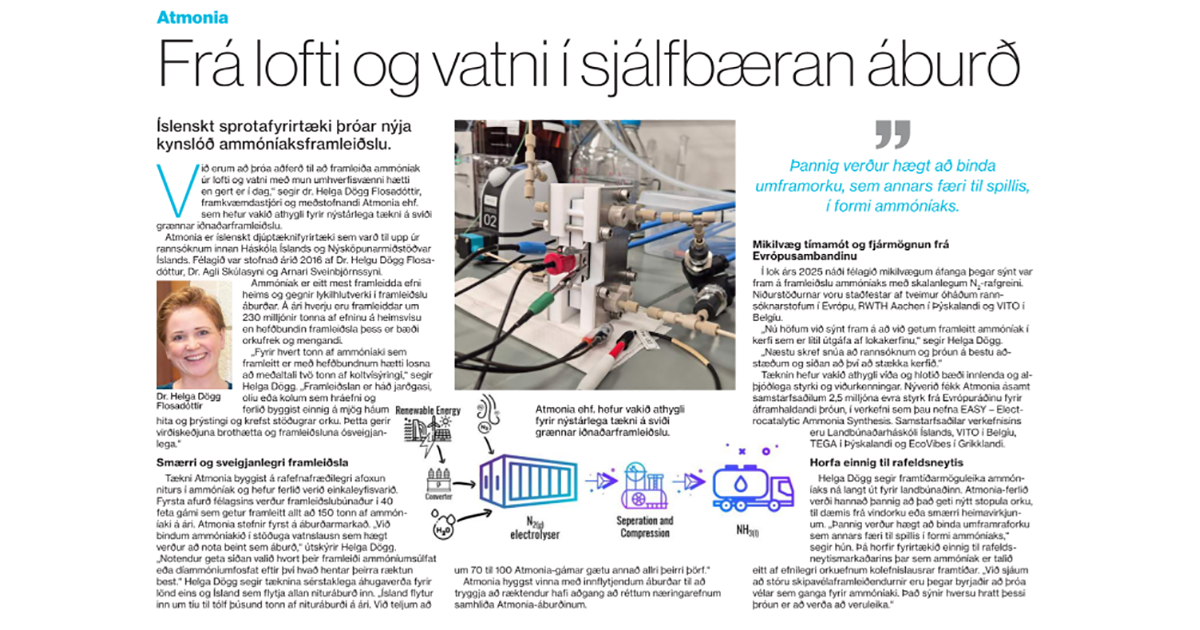
On May 29, an interview with Dr. Helga Dögg Flosadóttir, CEO of Atmonia ehf., was published in the Icelandic Newspaper Morgunblaðið.
“We are developing a method to produce ammonia from air and water in a much more environmentally friendly way than is done today,” says Dr. Helga Dögg Flosadóttir, CEO and co-founder of Atmonia ehf., a company that has attracted attention for its innovative green industrial technology.
Atmonia is an Icelandic deep-tech company that emerged from research conducted at the University of Iceland and the Icelandic Innovation Center. The company was founded in 2016 by Dr. Helga Dögg Flosadóttir, Dr. Egill Skúlason, and Arnar Sveinbjörnsson. Atmonia is part of the investment portfolio of the Business Venture Fund Kría, which first invested in the company in 2022.
Ammonia is one of the most widely produced chemicals in the world and plays a crucial role in fertilizer production. Around 230 million tonnes are produced globally each year, but conventional production is both energy-intensive and highly polluting.
“For every ton of ammonia produced using conventional methods, an average of two tons of carbon dioxide are emitted,” says Helga Dögg. “Production depends on natural gas, oil, or coal as feedstocks, and the process also requires very high temperatures and pressures, along with a constant energy supply. This makes the value chain vulnerable and production inflexible.”
Atmonia’s technology is based on the electrochemical reduction of nitrogen to ammonia, and the process has been patented. The company’s first product will be a production unit housed in a 40-foot shipping container capable of producing up to 150 tonnes of ammonia per year. Atmonia’s initial target market is fertilizer production.
“We bind the ammonia into a stable aqueous solution that can be used directly as fertilizer,” explains Helga Dögg. “Users can then choose whether to produce ammonium sulfate or diammonium phosphate, depending on what best suits their crops.”
Helga Dögg says the technology is particularly attractive for countries like Iceland, which imports all of its nitrogen fertilizer.
“Iceland imports around 10,000 to 12,000 tonnes of nitrogen fertilizer annually. We estimate that approximately 70 to 100 Atmonia containers could meet the country’s entire demand.”
Atmonia plans to work with fertilizer importers to ensure that growers have access to the necessary nutrients alongside Atmonia fertilizer products.
At the end of 2025, the company reached a major milestone by demonstrating ammonia production using a scalable nitrogen (N₂) electrolyzer. The results were verified by two independent European laboratories: RWTH Aachen in Germany and VITO in Belgium.
“We have now demonstrated that we can produce ammonia in a system that is a smaller-scale version of the final commercial system,” says Helga Dögg.
“The next steps involve further research and development to determine the optimal operating conditions and then scaling up the system.”
The technology has attracted significant attention and received both domestic and international grants and awards. Recently, Atmonia and its partners were awarded a €2.5 million grant from the European Innovation Council for continued development through the EASY project (Electrocatalytic Ammonia Synthesis).
Project partners include the Agricultural University of Iceland, VITO (Belgium), TEGA (Germany), and EcoVibes (Greece).
Helga Dögg says the future potential of ammonia extends far beyond agriculture. The Atmonia process is being designed to utilize intermittent renewable energy sources, such as wind power or small-scale local power generation.
“This will make it possible to store surplus electricity that would otherwise go to waste in the form of ammonia,” she says.
The company is also looking toward the e-fuels market, where ammonia is considered one of the most promising energy carriers for a carbon-free future.
“We are already seeing major marine engine manufacturers developing engines that run on ammonia. That shows how quickly this transition is becoming a reality.”


