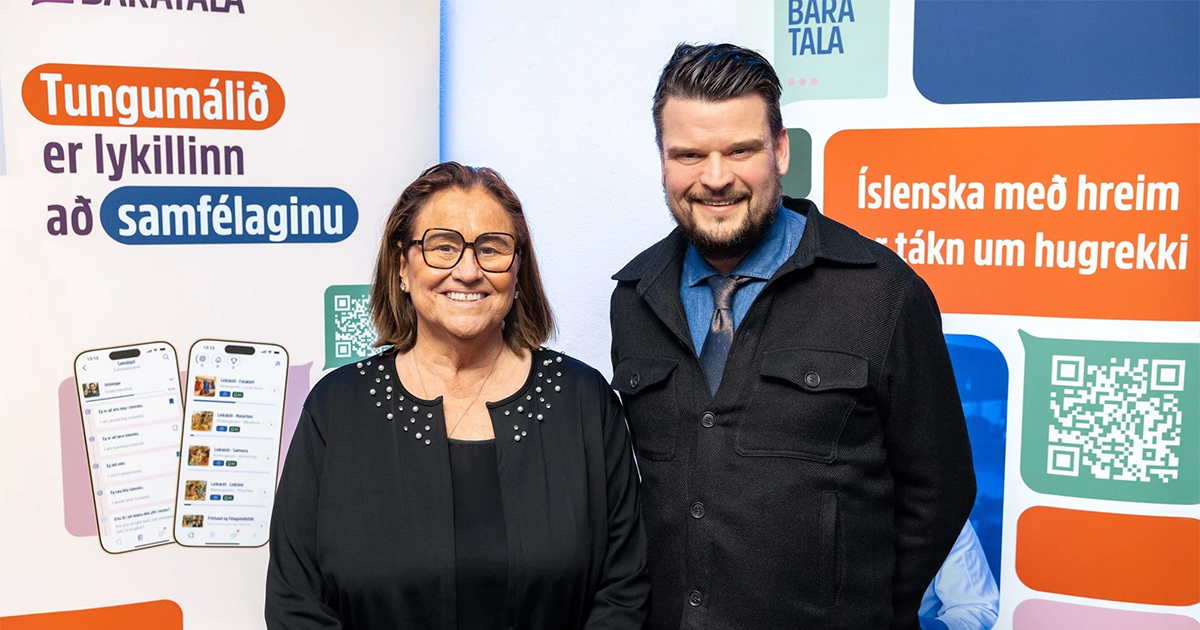
The language technology company Bara tala has received a 25 million ISK grant from the Ministry of Education and Children for a development project aimed at strengthening Icelandic language learning for upper secondary school students whose first language is not Icelandic. The project is carried out in close collaboration with the schools Tækniskólinn, Verzlunarskóli Íslands, Verkmenntaskóli Austurlands and Framhaldsskólinn á Húsavík. Its goal is to bridge the gap between language learning and vocational/academic studies at the upper secondary level.
According to data from Statistics Iceland, around 9% of upper secondary students in 2024 were of foreign origin, and the proportion is even higher in certain study programs.
“For this group, a lack of specialized academic vocabulary can become a real barrier to learning, even when interest, ability, and motivation are present. The need for practical and targeted academic support is therefore great—especially support that enables students to understand course material, actively participate in class, and build confidence in using Icelandic."
Currently, more than 160 digital courses are offered through Bara tala, with an emphasis on work-related Icelandic and Icelandic useful in everyday life. The project involves developing digital learning materials and subject-specific vocabulary that allow students to acquire Icelandic directly in connection with their studies—whether in academic programs, technical fields, or vocational training.
“By integrating Icelandic directly into students’ subject studies, in a digital and accessible format, one of the main challenges faced by immigrant students in upper secondary schools is being addressed, as Icelandic language instruction has more often run parallel to their studies rather than being integrated into them,” says a statement from Bara tala.
In a recent OECD review of the situation of immigrants in Iceland, Icelandic is described as a key prerequisite for inclusion in society, both within the education system and the labor market. The report notes that only about 18% of immigrants in Iceland say they have good proficiency in Icelandic—the lowest proportion among OECD countries.
“A lack of Icelandic proficiency is also one of the main reasons people are unable to fully utilize their education and skills. The OECD emphasizes the need to strengthen accessible, flexible, and practical Icelandic language instruction that is directly connected to studies, work, and daily life, where digital solutions such as Bara tala play a key role.”
Bara tala var stofnað árið 2023 og kom inn í eignasafni Nýsköpunarsjóðsins Kríu árið 2024,
Bara tala was founded in 2023 and became part of the investment portfolio of the New Business Venture Fund Kría in 2024.


